

Dual Enrollment & Implications for Post-Secondary Opportunities
by Luangchee Xiong
Dual enrollment is a bridge that connects high school to college, transforming what’s possible for students’ postsecondary journeys. As a counseling practitioner with roots embedded in developing a dual enrollment program, I have come to realize that for that promise to hold, schools must carefully consider the design, advising, and system-level supports that make these programs work for there are two sides to every story and in support of student success, school practitioners must be willing to address both.
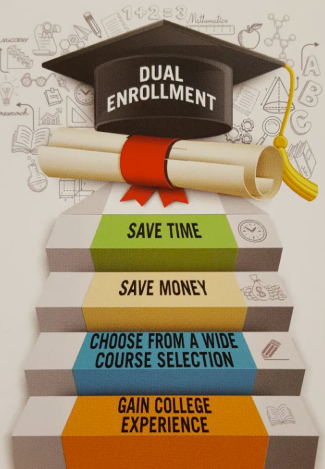
Source: Liberty County School System
Why Dual Enrollment Matters for Postsecondary Success
Imagine an emerging practitioner in her master’s program sitting on the floor of a small office with binders surrounding her filled with student paperwork to participate in contracted college courses trying to determine which student had an active account, which student completed concurrent enrollment paperwork versus the college application only, and which paperwork was meant for which student. Yes, that’s how old I am - before technology took off and before dual enrollment via the College and Career Access Pathway (CCAP) was established.
I created systems to ensure I knew which students had completed which aspect of the process and put together binders that were organized by alphabetical letters by last name and grade to ensure I was able to find student paperwork when needed. I knew the benefits of dual enrollment but never truly understood its potential because I had my foot on the ground building a program. A few years into the program’s growth, I saw the power of dual enrollment come to life when I watched members of the class of 2014, the second graduating class of the high school I was with, graduate with their Associates degree weeks before receiving their high school diplomas. The students had so much pride and were so excited to have the opportunity to walk into higher education a couple of years ahead.
I experienced so much joy watching the scholars I worked with walk across the high school stage wearing their college regalia. I continued to strengthen and streamline the systems I built every year. Along the way, I discovered the implications for considerations through trial and error. I was able to support students in earning their Associate degree and with each graduating class, I learned a number of things that are important to share with students and families and now, with fellow practitioners, to be able to expand our reach.
Dual enrollment allows students to take college courses while still in high school, with credits often counting toward both their diploma and college degree. When implemented equitably and supported by strong advising systems, it reshapes postsecondary outcomes in three critical ways:
Accelerated College Progress – Students can reduce both the time and cost of earning a degree or certificate. Completing even part or all of the 60 units required for an Associate degree and all or part of the credits required for a certificate, giving students momentum and saving families money.
Expanded Postsecondary Options – Dual enrollment widens the range of choices available after high school because students enter with advanced standing toward earning certificates or degrees. This also allows students to explore programming, such as study abroad.
College Readiness & Confidence – Students learn how to navigate college systems, manage advanced coursework, and understand financial aid and privacy policies before stepping onto a full-time college campus.
📊 Data Snapshot: Postsecondary Impact of Dual Enrollment
Higher College Enrollment: Participants are 12 percentage points more likely to enroll in college immediately after high school.
Improved Persistence: Students are more likely to return for their second year of college.
Increased Degree Completion: Dual enrollment students are more likely to earn a Bachelor’s degree.
Equity Impact: Well-designed programs help close gaps for first-generation, low-income, and students of color.
Key Considerations for Dual Enrollment Programming
Designing a strong dual enrollment program goes beyond access—it requires anticipating the implications for students’ long-term success and a willingness to share these implications with students and families.
Academic Standing
Grades earned in dual enrollment courses appear on a student’s permanent college transcript. Poor performance can put students on academic probation before they officially enter college. Early alerts, tutoring, and progress monitoring are critical.
Financial Aid & Satisfactory Academic Progress (SAP)
Withdrawals, repeats, and failures all count toward financial aid eligibility calculations. Students must maintain GPA, course completion rates, and progress within a maximum timeframe to qualify for grants and loans later. Advisors should explicitly connect dual enrollment performance to future FAFSA or CADAA outcomes. (Professional Development Opportunity: Contigo Ed Satisfactory Academic Progress session)
FERPA & Family Communication
College professors and institutions cannot legally share student performance with parents under FERPA. However, parents still retain the rights under FERPA at the high school and may inspect and review any records sent by the postsecondary institution to the high school. Thus, high schools and colleges must work together to set up communication protocols that keep families informed without violating privacy law. (Source: US Department of Education, Protecting Student Privacy)
Athletic Eligibility
Students who complete an Associate degree may be classified as college graduates, which can affect NCAA or community college athletic eligibility. Advising for student-athletes must account for these rules.
Course Planning & Credit Transfer
Not all credits transfer equally. Universities—especially private, independent, and out-of-state institutions—have their own policies. Counselors must help students understand articulation agreements and build plans that keep all options open.
Equity & Access
Barriers like GPA cutoffs, confusing enrollment forms, or lack of transportation often exclude underrepresented students. Districts should review participation data by subgroup, simplify processes, and provide support like tutoring, mentoring, and translation for families.
What This Means for Practitioners & Systems
To maximize the impact of dual enrollment on postsecondary success, schools and colleges must:
Co-design pathways that align high school graduation, general education, and transfer requirements.
Train advisors to explain the long-term consequences of dual enrollment decisions on transcripts, financial aid, and athletics. (Professional Development Recommendation: Contigo Ed Group & Individual Advising)
Monitor equity gaps in participation and completion, then build targeted supports.
Strengthen partnerships between K–12 and colleges, with clear MOUs, data-sharing, and family outreach.
The California Community Colleges Chancellor’s Office offers an Equitable Dual Enrollment Policy to Practice Guide (PDF) for secondary schools as a template for building out such a program.
Final Thoughts
Dual enrollment is not just about getting ahead in high school. It is about transforming postsecondary opportunities—accelerating degree completion, expanding career options, and preparing students to thrive in college.
When systems account for academic standing, financial aid, FERPA, athletics, and equity, dual enrollment becomes more than a course—it becomes a catalyst for lifelong opportunity.
Explore how Contigo Ed can help your district strengthen advising systems and equity-driven programming: Contigo Ed Resources.
